
Walking Through History
Inside the Rebuilt Kayanase Longhouse

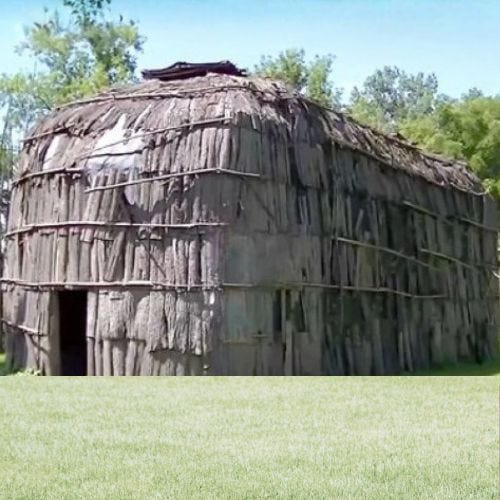
The tourism department of my Rez’s band council recently offered employees a chance to tour a rebuilt longhouse, a replica of a 17th-century Haudenosaunee (Iroquois) dwelling. The agency responsible for it, Kayanase, established the Ęjidwahsrö:ni’ (”We will build again”) Fund after their original longhouse was destroyed by arson.
Balancing Authenticity with Modern Safety
The current longhouse comes as close to historical accuracy as possible in the modern day, but certain compromises are necessary for health and safety reasons. These adaptations offer a fascinating glimpse into the challenges of preserving Indigenous heritage while meeting contemporary building codes.
Lighting and Heating Challenges
Currently, the only light sources are a smokehole and sunlight through open doors. What can be seen is intriguing, but details are difficult to make out in the semi-darkness. Anyone with vision problems would struggle to see anything at all.
Traditionally, fires would have been lit inside for both light and heat. However, an open hearth on the ground floor is now considered a fire hazard, especially for children. While pictures show the original longhouse with fires burning inside, the fact that it was lost to arson may make them hesitant to risk open flames again, even though the fire wasn’t caused by the fire pit.
The solution? Kayanase plans to install electric lighting and heating. They won’t install a furnace, but heaters will be added for the comfort of elders and to make the space accessible year-round.
Platform Sleeping Areas Without Ladders
The longhouse features three platforms on both sides of the building, replicating the traditional sleeping and storage arrangements:
First level: For children, elders, and the infirm
Second level: For mobile and healthy clan members
Third level: For storage
However, the historically accurate ladders cannot be included due to safety concerns. They would pose risks to tourists walking underneath them, likely wouldn’t meet modern safety codes, and could create liability issues if visitors attempted to climb them.
Construction Methods: Ancient Meets Modern
Our tour guide explained that while ancestors traditionally lashed beams together with fiber cords, this longhouse uses screws and nails. This may actually be safer, as modern builders might lack the skill to create fiber lashings strong and tight enough.
It also occurred to me later that our ancestors may have adopted screws and nails for longhouse construction after European contact; a question I wish I’d asked during the tour.
Demonstrating Traditional Life and Medicine
One of the most fascinating aspects of the tour was seeing how Kayanase used plants from their own greenhouse to demonstrate how medicines were collected and dried in longhouses. Unfortunately, these details were hard to make out in the darkness.
I wonder whether they’ll eventually collect enough plants to give tourists a complete picture of all the medicinal plants and furnishings used in a traditional longhouse, or if they can only afford to show samples.
For example, they displayed some white pine branches that were used as mattresses on the sleeping platforms, though surely enough would have been gathered to cover the entire sleeping surface. We were also told that pelts would have been layered on top of the pine branches, but acquiring even one pelt for demonstration purposes may be too expensive. It will be interesting to see what they add before opening to the public.
Modern Necessities: Doors and Fire Exits
For security reasons, the entrance and exit is currently a locked shed door that acts as a lobby. Once you step through, you encounter an authentic longhouse entrance. I believe I also spotted a modern side door in the darkness—likely required as a fire escape to meet modern fire codes.
Size and Spatial Constraints
Though the longhouse is the size of a modern large home, it’s actually small for a historical longhouse. Typically, Haudenosaunee families lived with their immediate and extended maternal relatives, requiring much larger structures.
Modern safety requirements also prevented the side platforms from extending along the walls as they would have historically, further limiting the authentic spatial experience.
The Missing Palisade and Future Plans
Though council employees were given tours, construction isn’t finished yet. The tour guide mentioned that palisades in old times served both as defense and as snow and windbreaks. Since the original longhouse structure had a palisade that burned down, they’ll probably construct one for the new building as well.
Haudenosaunee Science and Engineering
This project beautifully demonstrates Haudenosaunee science and engineering knowledge. The people building the longhouse had to understand which trees would be best for beams and shingles, as well as which plants could be used to create the fiber for lashing joints together the traditional way.
Final Thoughts
I deeply appreciate that our tour guide was forthcoming about deviations from historical design. Even with these necessary alterations, it was wonderful to get visuals of how my ancestors lived.
The longhouse is not yet open to the public, but it will be worth visiting once the electric heat and lights are installed. The improved lighting will allow visitors to better appreciate the interior details. Without heating, the best time to visit will be summer, as spring and fall weather may not be ideal for tours, and it definitely could not be done in winter.
The original longhouse was built as a form of ecotourism, and this rebuilt version promises to continue that legacy, honoring the past while adapting to present-day realities.
